
Knee Replacement: How Do You Know When It Is Time?

Deciding whether to have a knee replacement is rarely as simple as looking at an X ray.

Two people can have very similar knee osteoarthritis on imaging and make completely different decisions about surgery. One may feel that their quality of life has deteriorated to the point where a knee replacement is the right next step. The other may decide that their symptoms remain manageable and continue with conservative treatment.
Neither decision is necessarily wrong.
Knee replacement can be an excellent treatment for appropriately selected people with knee osteoarthritis. The challenge is determining whether it is the right treatment, for the right person, at the right time.
That requires looking beyond the scan.
Table of Contents
When should you consider a knee replacement?
There isn't one test, symptom or X ray finding that tells somebody it is time for a knee replacement.
Instead, several things need to be considered together.

These include:
The severity and frequency of pain
Walking tolerance
Difficulty with stairs
Sleep disturbance
Ability to work
Ability to exercise
Independence
Activities you have stopped doing
The effect on your overall quality of life
What conservative treatment has already been tried
Your general health
Your expectations of surgery
Your personal circumstances
Whether you actually feel ready for an operation
This makes knee replacement a shared decision, rather than something that should be determined by an X ray alone.
For some people, persistent pain and loss of function make the decision relatively straightforward.
For others, there is a much greyer area where understanding the available options becomes particularly important.
Does severe arthritis on an X ray mean you need surgery?
No.
X rays are useful when assessing knee osteoarthritis, particularly when knee replacement is being considered.
They can demonstrate features including joint space narrowing, osteophytes and other structural changes associated with osteoarthritis.
But an X ray cannot tell us how much pain somebody experiences.
It cannot tell us how far they can walk.
It cannot tell us whether they are sleeping.
It cannot tell us whether they can play golf, look after their grandchildren or continue working.
And it certainly cannot tell us whether they want an operation.
There can be a considerable mismatch between structural changes on imaging and an individual's symptoms and function.
Someone can have advanced osteoarthritis on an X ray and remain surprisingly functional.
Another person may experience substantial symptoms despite apparently less severe radiographic change.
This is why phrases such as “bone on bone” need to be interpreted carefully.
The imaging matters.
But it is one part of a much bigger clinical picture.
How bad does knee pain need to be for a knee replacement?
There is no particular pain score somebody needs to reach.
Pain matters, but the consequences of the pain are often more useful.

Consider someone whose knee hurts every day but who can still walk comfortably, sleep well, work and participate in the activities that matter to them.
Now compare that with somebody whose pain is disrupting sleep, substantially limiting walking and causing them to withdraw from activities they value.
The numerical pain score may not adequately describe the difference between those situations.
The decision therefore needs to consider how much the knee is affecting the person's life.
Some useful questions include:
What have you stopped doing because of your knee?
How much are you having to plan your life around it?
Is your world gradually becoming smaller because of the knee?
Are there more bad days than good days?
Are you still able to do the things that matter most to you?
These questions often tell us considerably more than asking somebody to rate their pain out of ten.
What should you try before knee replacement?
For most people with knee osteoarthritis, surgery should not be the first treatment.
There are several evidence based conservative approaches that may improve symptoms and function.
Exercise is central to this.
Depending on the individual, rehabilitation may address:
Quadriceps strength
Hip strength
General lower limb capacity
Balance
Walking tolerance
Cardiovascular fitness
Specific activities that have become difficult
Physical activity should also be encouraged rather than somebody being advised to protect an arthritic knee indefinitely.
Weight management can be helpful for people where this is relevant and something they wish to address.
Appropriate pain relief can be discussed with a GP or pharmacist.
Other treatments, including injections, may occasionally be considered depending on the individual circumstances.
The important point is that having osteoarthritis does not mean somebody simply waits until their knee becomes bad enough for surgery.
There is often a considerable amount that can be done before reaching that point.
How do you know if conservative treatment has genuinely been optimised?
This is one of the most important questions in the whole decision.
People will understandably say:
“I've already tried physiotherapy.”
But that can mean many different things.
For one person, it might mean they were given a generic exercise sheet and completed the same exercises for several weeks.
Another may have completed months of progressive rehabilitation with objectively improving strength, appropriate load progression and exercises specifically designed around the activities they want to regain.

Those are not equivalent experiences of conservative management.
Before concluding that physiotherapy has failed, it is useful to consider:
Were the exercises appropriate?
Were they sufficiently challenging?
Was resistance progressively increased?
Did strength actually improve?
Was the programme personalised?
Was overall physical activity considered?
Were symptoms and load appropriately managed?
Did rehabilitation address the activities the person actually wants to perform?
Were other appropriate treatment options discussed?
Sometimes there is considerable scope to improve conservative management.
Sometimes there isn't.
Recognising the difference matters.
The goal should not be to keep somebody in physiotherapy indefinitely simply because surgery is considered a last resort.
If conservative management has genuinely been optimised and somebody's quality of life remains unacceptable, an orthopaedic opinion may be entirely appropriate.
Are knee injections worth trying before surgery?
Sometimes, but an injection is not automatically a compulsory step before knee replacement.
Corticosteroid injections can provide short term symptom relief for some people with knee osteoarthritis, although the duration and magnitude of benefit vary.
Other injectable treatments are also available, including hyaluronic acid and platelet rich plasma, commonly known as PRP. The evidence and recommendations surrounding different injectable treatments vary, and availability differs between NHS and private healthcare.
The important question is not simply:
“Can I have an injection?”
It is:
“What are we hoping the injection will achieve?”

For somebody trying to delay surgery temporarily because of work, travel or personal circumstances, a period of symptom improvement might have considerable value.
For another person whose quality of life is already substantially affected and who is otherwise ready for knee replacement, repeatedly pursuing short term treatments may simply delay a more appropriate intervention.
Again, context matters.
Can you be too young for a knee replacement?
Age is relevant, but there should not be a simplistic age threshold at which somebody suddenly becomes eligible for a knee replacement.
Historically, people have sometimes been told they are “too young” and should wait as long as possible before considering surgery.
There is logic behind some of this caution.
A younger person potentially has many more years in which to use the replacement, increasing the possibility that revision surgery may eventually be required. Activity expectations may also be different.
But delaying surgery also has consequences.
If somebody spends years with substantially impaired mobility, poor sleep and unacceptable quality of life simply to reach an arbitrary age, that needs to be weighed against the potential benefits of having surgery sooner.
The decision should therefore consider age alongside symptoms, function, expectations, general health, likely longevity of the implant and the individual's priorities.
Age matters.
It should not make the decision by itself.
How do your personal circumstances affect the decision?
This part is sometimes underestimated.
Imagine two people with very similar knee osteoarthritis.
Their X rays look similar.
Their pain levels are similar.
Their walking tolerance is similar.
Clinically, they might appear to be at approximately the same point.
But their lives may be completely different.
One has a supportive partner, family nearby, flexibility around work and feels ready to commit to the recovery and rehabilitation following surgery.
The other is the main carer for a husband with dementia.
Having an operation would temporarily affect her mobility and independence, and she may have nobody who can adequately take over her caring responsibilities during recovery.
The appropriate decision for those two people right now could be completely different.
The second person may ultimately benefit just as much from knee replacement.
But this may simply not be the right time.
Alternatively, recognising how much the knee is affecting her ability to continue caring may make arranging additional support and proceeding with surgery more important.
There isn't a formula that can make that decision.
This is why understanding the person is as important as understanding the knee.
What should you expect from a knee replacement?
Expectations matter.
A knee replacement is intended primarily to improve pain and function in people with significant knee arthritis.

For many people it can produce substantial improvements in quality of life.
But a replaced knee does not necessarily become a completely normal knee.
Recovery requires time and rehabilitation.
There will be an initial period of pain, swelling and reduced function following surgery.
Walking and everyday activities then progressively improve as recovery continues.
People also have different goals.
For one person, success may mean walking comfortably around the shops and managing stairs.
For somebody else, it may mean returning to golf, cycling, hiking or more demanding recreational activity.
Those expectations should be discussed before surgery rather than afterwards.
A successful knee replacement is not simply a technically successful operation.
The outcome needs to be meaningful to the person having it.
When should you see a knee surgeon?
You do not necessarily need to wait until you have decided that you definitely want surgery before obtaining an orthopaedic opinion.
Sometimes the purpose of seeing a knee surgeon is to understand whether knee replacement is a reasonable option.
An opinion becomes particularly useful when:
Knee osteoarthritis is significantly affecting quality of life
Appropriate conservative management has been optimised
Symptoms remain unacceptable
Imaging and the clinical presentation correspond
You want to understand the likely benefits and risks of surgery
You are uncertain whether continuing conservative treatment remains worthwhile
Seeing a surgeon does not commit somebody to having surgery.
It provides another piece of information that can help with the decision.
Equally, an orthopaedic surgeon does not necessarily need to be the first person to determine whether conservative treatment has been fully explored.
Different clinicians bring different expertise to the decision.
How can an Advanced Physiotherapist help with the decision?
There is often a stage in knee osteoarthritis where the question is no longer simply:
“What exercises should I do?”
It becomes:
“Have I done everything reasonable without surgery, and what should I do next?”
This is where a thorough Advanced Physiotherapy assessment can be particularly useful.
There needs to be enough time to understand more than the painful knee.
What is the diagnosis?
Do the symptoms and imaging findings correlate?
What has already been tried?
Was rehabilitation genuinely optimised?
What is strength and function currently like?
What activities matter to the person?
What are they currently unable to do?
What are their expectations?
What concerns do they have about surgery?
And what is happening in the rest of their life?
Sometimes that assessment identifies worthwhile conservative options that have not yet been properly explored.
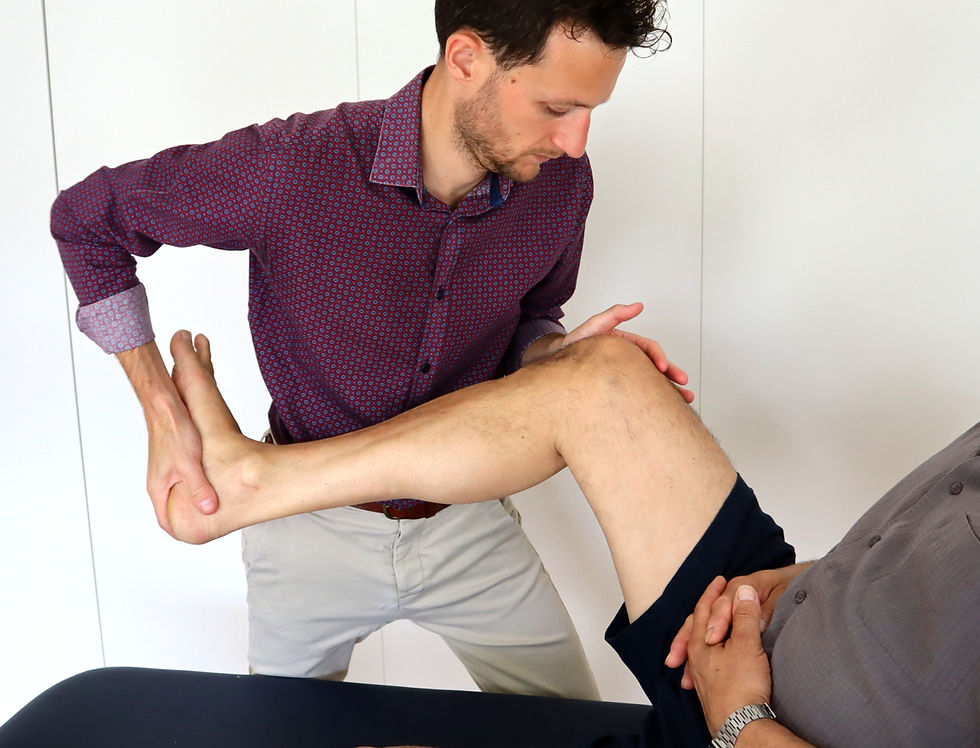
Sometimes it becomes clear that conservative management has been very well optimised and continuing to repeat it is unlikely to change the situation substantially.
At that point, helping somebody access an appropriate orthopaedic opinion may be the most useful thing I can do.
The role of an Advanced Physiotherapist should not be to keep somebody in physiotherapy.
It should be to help them make a well informed decision about the most appropriate next step.
A useful NHS knee replacement decision making tool
The NHS has produced a decision support tool for people with knee osteoarthritis that I think is genuinely useful.
Rather than focusing exclusively on X rays or pain scores, it encourages people to consider how knee osteoarthritis affects different aspects of their life and understand the benefits and potential harms of different treatment options.
It considers areas including pain, sleep, everyday activities, work, relationships and emotional wellbeing.
This is important because the decision to have a knee replacement is ultimately a shared decision.
The evidence matters.
The clinical assessment matters.
The imaging matters.
But what matters to the individual is equally important.
If you are beginning to wonder whether you should consider knee replacement, working through the NHS decision support tool can be a useful starting point before discussing your options with an appropriate healthcare professional.
Frequently Asked Questions
How do you know when it is time for a knee replacement?
There is no single threshold. Knee replacement is generally considered when knee osteoarthritis is substantially affecting symptoms, function or quality of life despite appropriately optimised conservative management, and the individual feels the potential benefits of surgery outweigh the disadvantages.
Does bone on bone arthritis mean I need a knee replacement?
No. Significant structural changes on an X ray do not automatically mean surgery is required. Symptoms, function, quality of life, personal goals and response to conservative treatment all need to be considered alongside imaging.
How bad does knee pain need to be before surgery?
There is no particular pain score required. The effect of the knee on walking, sleep, independence, work, exercise and overall quality of life is generally more useful than a numerical pain score alone.
Should I try physiotherapy before knee replacement?
For most people, appropriately structured exercise and rehabilitation should form an important part of non surgical management. However, repeatedly continuing physiotherapy despite well optimised rehabilitation and unacceptable symptoms is not necessarily beneficial.
Can I be too young for a knee replacement?
Age is one factor in the decision because younger people potentially have a greater lifetime risk of requiring revision surgery. However, age should be considered alongside symptoms, function, quality of life and individual circumstances rather than used as an arbitrary barrier to surgery.
Do I need an MRI before a knee replacement?
Usually an MRI is not required simply to diagnose established knee osteoarthritis or decide whether knee replacement should be considered. Weight bearing X rays are generally much more relevant to assessing structural osteoarthritis. Additional imaging may be required in particular circumstances.
Should I have an injection before knee replacement?
Not necessarily. An injection may provide useful symptom relief for some people, but it is not automatically required before surgery. Its value depends on what you are trying to achieve and where you are within the overall treatment pathway.
Can I still be active after a knee replacement?
Many people return to substantial levels of physical activity following knee replacement. Appropriate activities and expectations depend on the individual, their recovery and advice from the surgical and rehabilitation teams.
Should I see a physiotherapist or knee surgeon first?
It depends where you are in the decision. If the diagnosis is uncertain or you are unsure whether conservative management has been fully optimised, an experienced musculoskeletal or Advanced Physiotherapy assessment can be useful. If there is already a clear surgical question, an orthopaedic opinion may be appropriate.
Unsure whether it is time for a knee replacement?
If knee osteoarthritis is increasingly affecting your life and you are unsure whether you should continue conservative treatment or consider surgery, get in touch with Genuine Physio.
A thorough assessment provides the time to consider the whole picture: your symptoms, function, imaging, previous treatment, goals and personal circumstances.
Sometimes there is still worthwhile conservative treatment to explore.
Sometimes there isn't.
And if the balance has shifted towards surgery, an appropriate knee orthopaedic opinion can be arranged.
Knee replacement is not simply about having a sufficiently bad X ray. It is about finding the right treatment, for the right person, at the right time.


Comments