
Bone on Bone Knee Arthritis: Does It Mean You Need a Knee Replacement?

Being told that you have “bone on bone” knee arthritis can sound alarming.
For many people, the immediate assumption is that the knee has worn out, there is nothing left to protect the joint and a knee replacement is now inevitable.

That is not always the case.
“Bone on bone” is a phrase commonly used to describe advanced osteoarthritis on an X ray, where there has been substantial loss of joint space. It can be an important finding, but it does not tell us everything we need to know about your knee.
Some people with advanced changes on X ray experience significant pain and loss of function. Others remain remarkably active despite having very similar looking joints.
The decision about whether you need a knee replacement should therefore never be based on the X ray alone.
Table of Contents
What does bone on bone knee arthritis actually mean?
Osteoarthritis is a condition affecting the whole joint.
Changes can occur within the cartilage, underlying bone, joint lining and surrounding muscles and tissues.
On an X ray, osteoarthritis may be associated with narrowing of the space between the bones, changes in the underlying bone and the formation of osteophytes, sometimes referred to as bone spurs.

When joint space narrowing becomes particularly advanced, people are sometimes told that their knee is “bone on bone”.
The phrase is useful as a simple description of what the X ray looks like, but problems arise when it is interpreted as a prediction of how much pain somebody should have or what treatment they require.
An X ray shows us structure.
It does not directly measure pain, strength, walking ability, confidence or quality of life.
Those things need to be assessed separately.
Does bone on bone arthritis always cause severe pain?
No.
There is a relationship between the severity of osteoarthritis seen on imaging and symptoms, but it is far from perfect.

Some people with relatively modest changes on an X ray experience substantial pain and disability. Others have advanced osteoarthritis but continue walking, exercising and participating in activities that are important to them.
Pain is influenced by considerably more than the amount of joint space visible on an X ray.
Strength, physical capacity, sleep, general health, previous activity, sensitivity of the pain system and other individual factors can all contribute to the symptoms someone experiences.
This does not mean the osteoarthritis is irrelevant.
It means the X ray needs to be interpreted alongside the person sitting in front of us.
A real example of why we should not treat the X ray
Recently, someone sent me a copy of a follow up letter from their orthopaedic consultant that illustrates this particularly well.

They had advanced hip osteoarthritis on X ray and had previously been placed on the waiting list for a total hip replacement.
However, after a period of exercise and self managed physiotherapy, their symptoms improved considerably.
They had even completed a nine hour mountain walk with only minimal discomfort.

Despite the X rays continuing to show advanced osteoarthritis, their symptoms were now relatively mild. Following discussion with their consultant, the decision was made that the balance of risks and benefits no longer favoured surgery at that time.
The X ray had not changed. The person had.
Although this example involves hip osteoarthritis, exactly the same principle is important when assessing knee osteoarthritis.
Imaging can provide valuable information about the joint, but it cannot tell us how much pain somebody should experience, what they are capable of doing or, by itself, whether they need a joint replacement.
Can you improve even if the arthritis is still there?
Yes.
This is one of the most important concepts to understand about osteoarthritis.
Successful treatment does not require us to reverse the changes seen on an X ray.
If someone becomes stronger, walks further, sleeps better, returns to exercise and experiences less pain, their condition has improved even though another X ray may look very similar.
This is why describing osteoarthritis purely in terms of “wear and tear” can sometimes be unhelpful.
It can create the impression that the joint will inevitably deteriorate until surgery becomes necessary.
That is not the experience of everyone with knee osteoarthritis.
Symptoms can fluctuate considerably, and there are often meaningful opportunities to improve pain and function without changing the structural appearance of the joint.
What treatment should you try before knee replacement?
For many people with knee osteoarthritis, conservative management should be properly explored before deciding whether surgery is necessary.
Exercise is a central part of this.
The aim is not simply to move the knee more. Rehabilitation may need to address strength around the knee and hip, general physical capacity, confidence with movement and the specific activities someone wants to return to.
The programme should also be appropriate for the individual.
Someone who wants to comfortably walk around the shops has very different requirements from someone who wants to continue playing golf, hiking or going to the gym.
Exercise dosage and progression matter too.

Simply being given a generic sheet of knee exercises does not necessarily mean conservative management has been optimised.
Other factors may also need addressing, including general physical activity, weight management where appropriate, sleep and management of other health conditions that may influence symptoms and recovery.
Pain relief may also have a role and can be discussed with an appropriate healthcare professional or prescriber.
The objective is not to avoid surgery at all costs.
It is to establish how well the knee can function with appropriately optimised conservative management before deciding whether an operation is necessary.
Can exercise make bone on bone arthritis worse?
This is an understandable concern.
If you have been told there is very little joint space remaining, loading the knee can feel counterintuitive. People sometimes worry that walking, squatting or strengthening exercises will wear the remaining joint away more quickly.
For most people with knee osteoarthritis, appropriate exercise is recommended rather than avoided.
The key word is appropriate.
Exercise needs to take account of your current symptoms, physical capacity and how the knee responds to load. This is the case at any stage of osteoarthritis.
Some discomfort during or following exercise does not necessarily mean that damage is occurring. Equally, repeatedly provoking a substantial and prolonged increase in symptoms is unlikely to be the best way to progress rehabilitation.

Finding the appropriate starting point and gradually increasing what the knee can tolerate is therefore important.
When might a knee injection be appropriate?
Injections can have a role in knee osteoarthritis, but they should be considered in the context of the overall management plan.
A corticosteroid injection may provide temporary symptom relief for some people.
That can occasionally be useful when pain is making it particularly difficult to exercise, sleep or function.
However, an injection does not reverse the osteoarthritis and should not automatically replace rehabilitation.
There are also other types of injection marketed for knee osteoarthritis, with varying levels of evidence and suitability.
The decision to have an injection should therefore involve understanding exactly what is being offered, what benefit is realistically expected and how it fits into the wider management of the knee.
When should you consider knee replacement?
Knee replacement can be an extremely effective treatment for appropriately selected people with advanced symptomatic knee osteoarthritis.
It should not be portrayed as a failure of physiotherapy or something that needs to be avoided indefinitely.
For some people, it is absolutely the right treatment.
The decision becomes more appropriate when pain and loss of function are having a substantial impact on quality of life and appropriate conservative options are no longer providing an acceptable level of function.
Factors that may contribute to the decision include:

The severity and persistence of symptoms
How significantly the knee is affecting everyday life
Walking and activity limitations
Sleep disturbance
Clinical examination findings
X ray findings
What conservative management has already been tried
Overall health and surgical risk
The individual's expectations and preferences
This is why two people with almost identical X rays may make completely different decisions about surgery.
For one person, knee replacement may offer a substantial improvement in quality of life.
For another, whose symptoms remain manageable and who is still doing everything they want to do, the balance of risks and benefits may favour continuing without surgery.
What if you have been told you need surgery but are not sure?
If you have been told that your knee is bone on bone or that you are likely to need a knee replacement, it is reasonable to want to understand the decision properly.
The important questions are not simply:
How bad does my X ray look?
They are also:
How much is the knee affecting my life?
Has conservative management genuinely been optimised?
What am I currently unable to do?
What would I hope to gain from surgery?
What are the alternatives?
If there is uncertainty around those questions, a further musculoskeletal assessment can be useful.
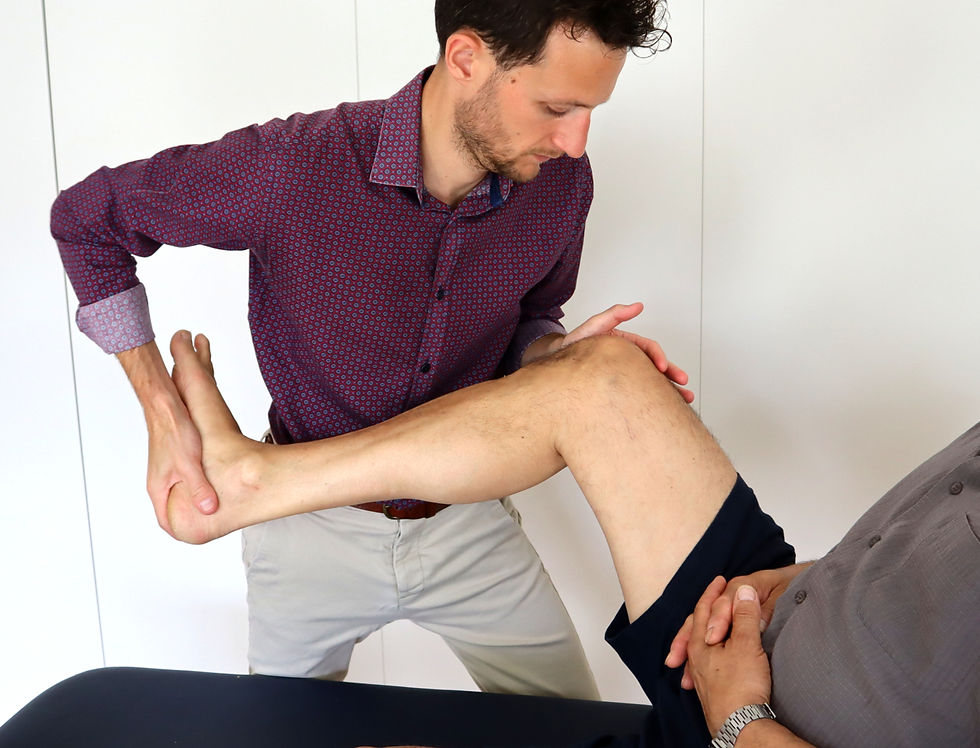
An Advanced Physiotherapist can help assess the knee, review what has already been tried and consider whether there is still scope to improve conservative management.
If knee replacement appears to be an appropriate option, an orthopaedic opinion is then exactly the right next step.
The aim should not be to avoid surgery or encourage surgery.
It should be to make the right decision for the individual.
Frequently Asked Questions
Does bone on bone knee arthritis mean there is no cartilage left?
The phrase usually describes very advanced joint space narrowing on an X ray. However, it is a simplified description and should not be interpreted as a complete assessment of the joint or a prediction of your symptoms.
Can bone on bone knee arthritis improve without surgery?
Symptoms and function can improve substantially even though the structural osteoarthritis remains. Exercise, strengthening, appropriate load management and other aspects of conservative care can all contribute to improvement.
Can you walk with bone on bone knee arthritis?
Yes. Many people with advanced knee osteoarthritis remain active. How much walking is appropriate depends on your symptoms, current capacity and response to activity rather than the X ray appearance alone.
Should I exercise if my knee is bone on bone?
In most cases, appropriate exercise is recommended for knee osteoarthritis. The programme should be individualised and progressed according to your symptoms, strength, function and goals.
How do I know when it is time for a knee replacement?
There is no single X ray finding or pain score that determines when someone should have a knee replacement. The decision should consider the impact of symptoms on quality of life, function, previous conservative management, imaging findings, overall health and your own preferences.
Should I get a second opinion before having a knee replacement?
If you understand the diagnosis and options and are comfortable with the recommendation, another opinion is not automatically necessary. However, if you remain uncertain whether conservative management has been fully explored or whether surgery is the right next step, seeking another appropriate clinical opinion can be useful.
Been told your knee is bone on bone?
If you have knee osteoarthritis and are unsure whether you should continue with conservative management, consider an injection or seek an orthopaedic opinion, get in touch with Genuine Physio.
At Genuine Physio in Tadworth, near Kingswood, my role as an Advanced Physiotherapist is to assess the whole clinical picture, not simply the X ray, and help you understand the most appropriate next step.


Comments